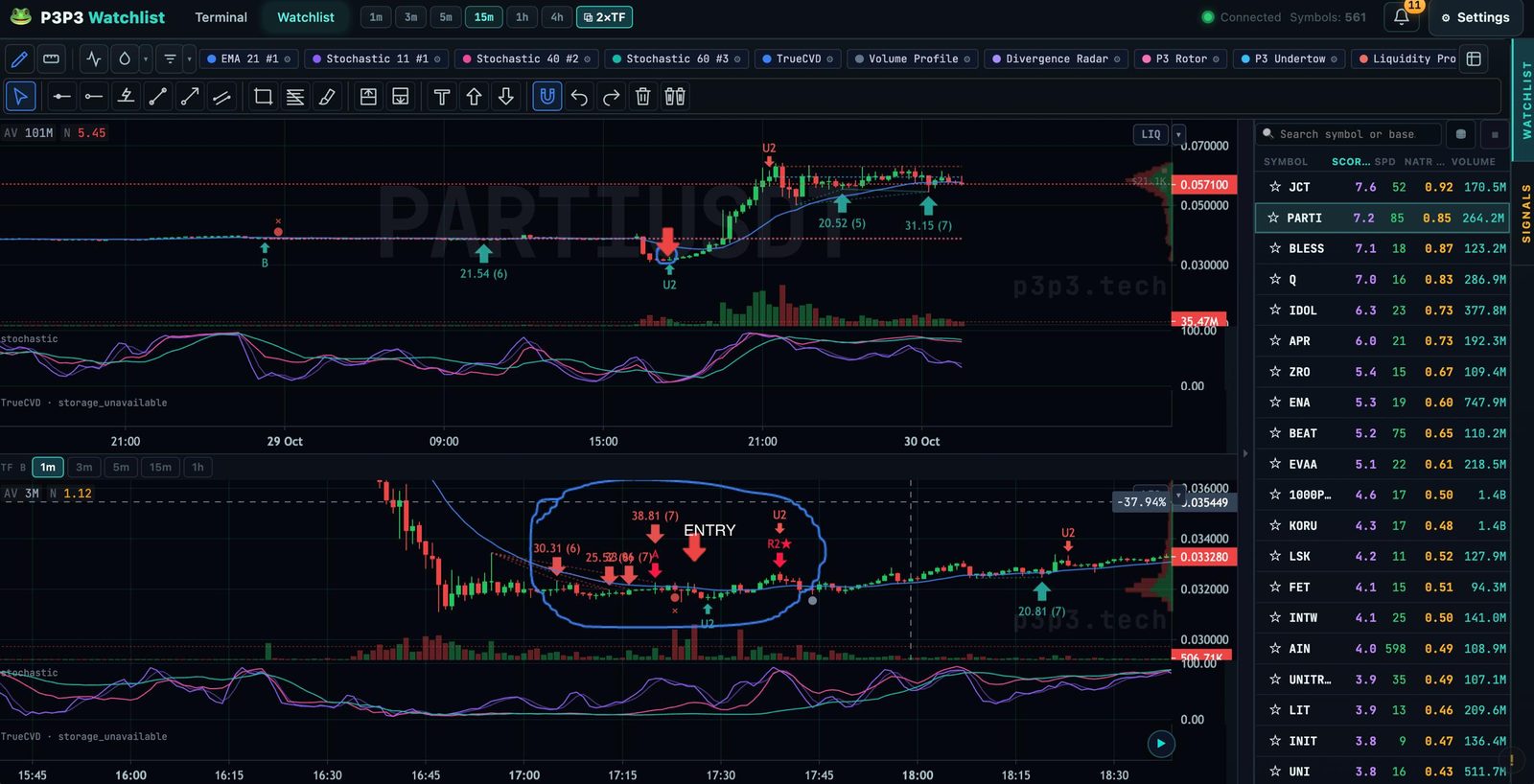
What happened
The coin (PARTI) had less than $50M in 24-hour volume before the move. That single number explains most of what followed: on volume that thin, a few aggressive buyers can move price by double digits and sweep the stops sitting above local highs, and every short becomes fuel for the move up. The thinner the book, the cheaper it is to engineer a pump and the more expensive it is to stand in front of one.
Filter 1 — 24-hour volume
My working floor is $80–100M of 24-hour volume. Scalpers I respect argue for $200M; that is the conservative side of the line, and conservative is the right side here. DOS is a good illustration: about $60M of daily volume, thirty hours of grinding higher, then −30% in five minutes with no bounce. There was no good exit. The market does not offer second chances.
Filter 2 — not every alert carries the same weight
People often ask which indicator in the screener is stronger. The honest answer: Divergence Radar above 20 outranks Undertow. Undertow fires on its own condition — “Divergence Radar found a bullish divergence with a total of 7.5 or more” — which is a lower bar. That is on us: we plan to raise the default threshold to 15–20 so the two indicators speak the same language.
Filter 3 — location beats the signal
Even if PARTI had passed the volume test, I would not have shorted it at the lows for continuation — not after two alerts, not after a news catalyst. The chart had already collapsed and was chopping at the bottom, which is the worst place to add risk in the direction of the dump. That is where squeeze after squeeze happens: every wick takes out the late shorts, and the position dies before the idea has time to work.
Filter 4 — the higher timeframe sets the direction
Our alerts look for reversals, but they are meant to be traded as trend mean reversion. If we are looking for a long, the move we are buying is a 10–50% counter-trend pullback inside a larger uptrend, and the higher timeframe is still up. A divergence at the bottom of a collapsed chart is not mean reversion: there is no trend left to revert to. So before entering, check where the higher timeframe points, and trade with it.
Filter 5 — the trigger
A signal is a reason to look, not an order to enter. Wait for a proper retracement, confirm that buying volume is actually there, see the signal candle — and only then enter. Without a trigger, a signal is just a picture.
Example 1 — BLESSUSDT
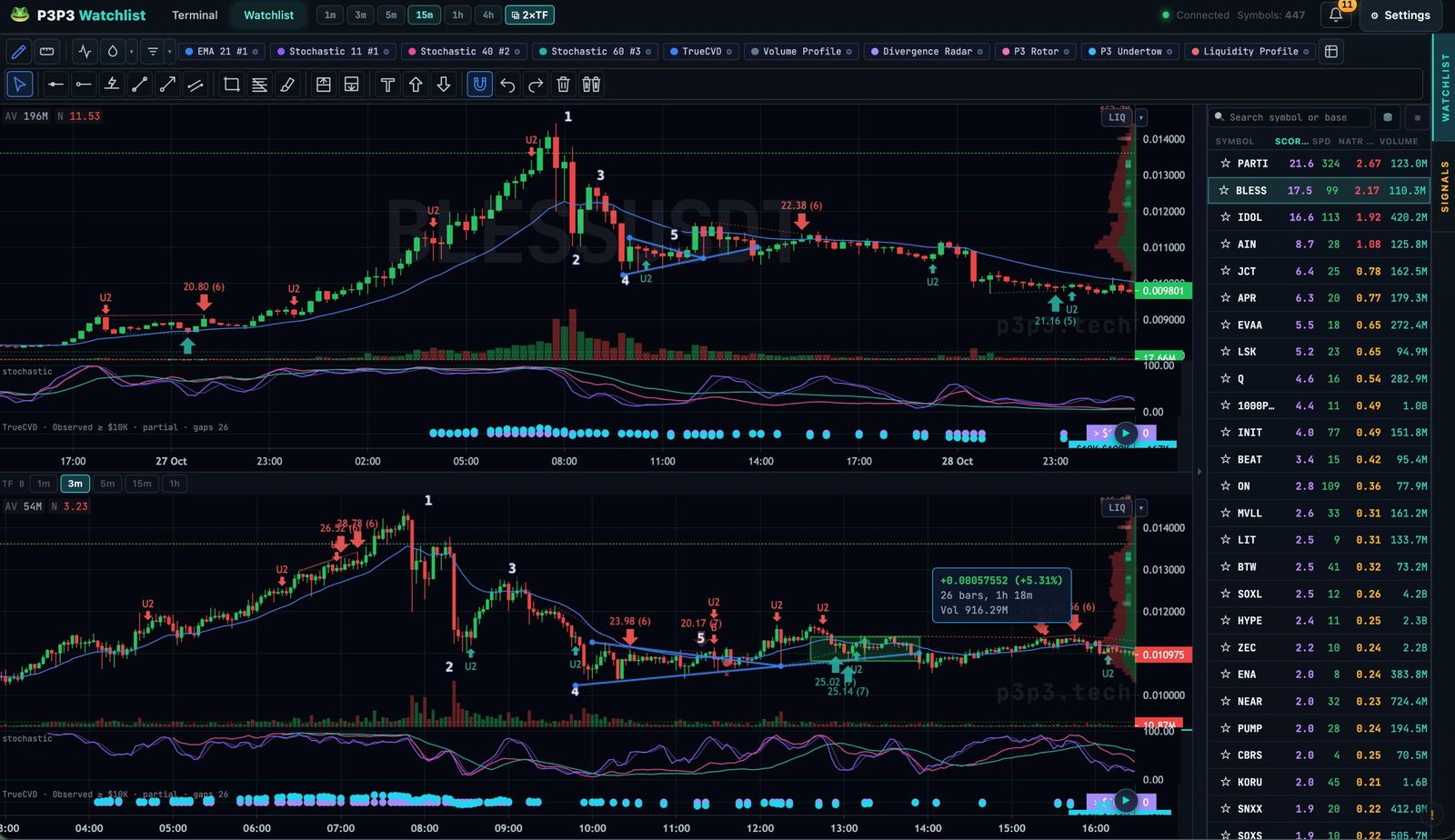
Two days earlier, 15m and 3m charts (5m/1m works too if the coin is liquid enough). Price had ground up nearly 80%; shorting that, alerts or not, invites a squeeze. Then four clean retracements, 1–2–3–4. The fifth zone rarely offers a clear entry: that is where the fight starts, where price compresses and setups are being formed. You look for a setup and an alert there, but you keep the bullish context in mind and size the short accordingly. The long that followed was reluctant: no real strength, no convincing long alerts, and the only one that appeared came during the decline, which made it a risky entry.
Example 2 — IDOLUSDT
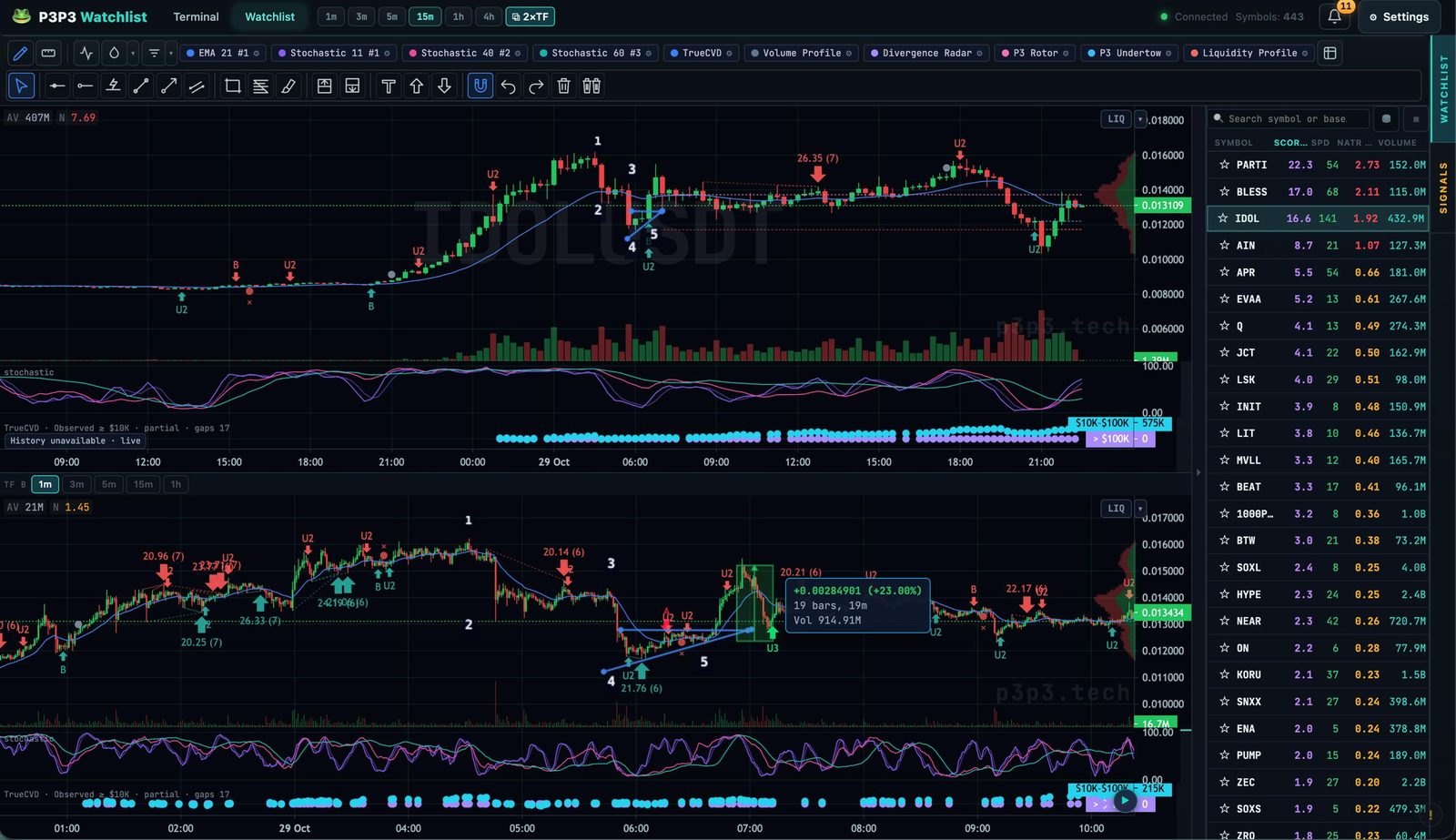
The next day, much the same picture: a 30% correction, but with several times the strength and volume. The signals were contradictory; taken at face value, the long would have paid 5% (DivR 21.76 + U2) and the short 2% (A + U2). The point is not that both worked. The point is that shorting a compressed setup after a 90% rally the previous evening is a red flag — I would take that short small, or not at all.
The checklist before any entry
1. Is 24-hour volume above $80–100M? Below that, a signal is a reason to look, not a setup.
2. Which indicator fired, and at what value? Divergence Radar above 20; Undertow from 7.5, soon 15–20.
3. Where is price relative to the move? No short continuation at the bottom of a dump, no long continuation at the top of a pump.
4. What does the higher timeframe say? Trade with it — a lower-timeframe signal against it is a pullback trade, not a reversal.
5. Is there a trigger? Wait for the retracement, check the volume, see the signal candle, then enter.
What we are changing in the product
Planned: a cumulative daily volume indicator, so the liquidity filter is visible inside the screener and not only in your head. Planned: raising the default Divergence Radar threshold to 15–20. These are tooling changes, not a promise of profit.
What stays with you
Signals tell you where to look; the stop, the size and the decision stay with you. This article is educational, not investment advice, and the examples are historical: they show the reasoning, not a guaranteed repeat.
Want to check the context on the next alert? Open the screeners — volume, higher-timeframe trend and the trigger are on the same screen.